
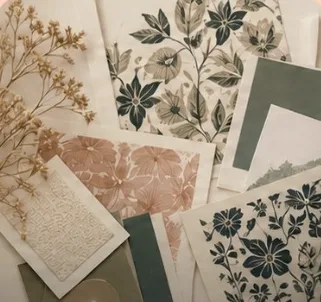
 Fabric designsPrinted by the yard
 Backdrop designsPhoto backdrops to hang
The best fabric for curtains, from sheer to blackout
Updated
Pick curtain fabric by the job: sheer for daylight, light-filtering for softened glare, privacy for street-facing windows, blackout for bedrooms. For blackout, use Blackout Drape on its own or as a lining behind a printed face. For fullness, buy 2 to 2.5 times the rod length in fabric width. Every Huevara design prints on every fabric, so the print never forces the choice.
Decide what the window needs to do
Before you look at prints, stand in the room at the time of day you use it most. A west-facing living room needs glare softened in the late afternoon. A bedroom needs darkness at six in the morning. A street-facing window needs privacy at night, once the lamps are on.
Curtain fabrics do four broad jobs: sheer, light-filtering, privacy and blackout. Pick the job first, then the fabric, then the print. Every Huevara design can be printed on any of our fabrics, so the print never forces the choice.
Sheer curtains: Chiffon, Crepe, Stretch Mesh and Feather Lawn
Sheers diffuse daylight and blur the view without blocking it. Chiffon (80 GSM, translucent) is the most fluid of the group and falls into soft folds, which suits long panels that sweep to one side on a tieback. Crepe (70 GSM) is partially translucent with a fine textured surface, so it reads a little more solid in the window. Stretch Mesh (70 GSM) is an open mesh with four-way stretch, better for swags and layered decorative panels than for a curtain you open and close every day. Feather Lawn (100 GSM) has a fine, even weave and gently defined folds, a good pick for cafe curtains on a kitchen or bathroom window.
Backlit, a sheer glows and fine print detail softens, so medium and large motifs read best. Chiffon is very light, so finish its edges carefully: a narrow double hem or a rolled hem stops fraying and keeps the panel airy.
Light-filtering curtains: the linen look fabrics
Light-filtering curtains cut glare and give daytime privacy while the room still feels bright. Signature Linen Look (100 GSM, partially translucent) has visible slubs and a relaxed drape with some body. It hangs in easy, casual folds and works well unlined in a living room or sunroom.
Vanilla Heritage Linen Look (270 GSM, partially translucent) has a heavier, pronounced woven texture. It has the presence of a drapery fabric but still lets light through, and suits layered drapery and lined Roman shade fronts. If you want more privacy from it after dark, line it.
Privacy and blackout curtains
Opaque decor fabrics stop people seeing in and give a room a finished, tailored look. Heritage Linen Look (360 GSM) is the most substantial. Luminous White Out (240 GSM) is opaque with a fine textured surface and some body. Signature Herringbone and Pebble Matte (both 260 GSM) add a directional weave or a matte face, and Plush Velvet (250 GSM) brings pile to a formal room.
Opaque is not the same as blackout. For a bedroom, guest room or media room that has to go dark, use Blackout Drape (220 GSM). It is made to block light, for darker, more private rooms. Light will still creep around the edges of any curtain, so mount the rod wider and higher than the frame and let the panels overlap at the center.
Blackout Drape asks for one habit at the machine: hem with a long stitch and keep pins out of the face, because every hole lets through a pinprick of light. Pin inside the seam allowance or use clips.
Lining: when and with what
A lining shields the printed face from direct sun, adds weight so panels hang straighter, and improves privacy. For a printed decorative face and a darker room, line it with Blackout Drape, which is meant for curtain and Roman shade linings as well as standalone panels. A light-filtering face such as Signature Linen Look keeps its texture when lined but loses its glow, so decide whether you want the light or the privacy.
Sheers are usually left unlined, often on a second rod behind an opaque pair so you can switch between day and night. Cut the lining 1 to 2 inches narrower than the face and about 1 inch shorter, so it never peeks out at the sides or the hem.
How much fabric to order
Measure the rod, not the window, and include any returns (the part that wraps back to the wall) and the overlap where two panels meet.
Width: multiply the rod length by 2 to 2.5 for gathered, pleated or grommet panels. Use the lower figure for heavy fabrics like Heritage Linen Look and the higher one for sheers, which look thin without plenty of fullness. Divide by the fabric width, roughly 53 to 58 inches depending on the fabric, and round up to whole widths. Allow 2 to 3 inches per width for side hems.
Length: take the finished length from the rod to where the curtain should stop, then add 8 inches for a double 4-inch bottom hem and 4 to 8 inches for the header, depending on whether you sew a rod pocket, pleat tape or grommets. That is the cut length for each width.
Example: a 60-inch rod at 2x fullness needs 120 inches of width, so three widths of a 57-inch fabric. At 84 inches finished, plus 8 for the hem and 6 for the header, each cut is 98 inches. Three cuts come to 294 inches, about 8 1/4 yards. With a large print, add one pattern repeat per width after the first so the motifs line up across seams and between panels.
Hold a swatch to the glass
Tape a swatch to the window in the morning, then look again at night with the lamps on. You will see right away whether a linen look fabric gives enough privacy and whether a print turns busy when backlit. The swatch kit puts our fabrics in your hands, so a sheer, a linen look and Blackout Drape can sit side by side before you commit to full lengths. You can also change the scale of any design before ordering, which matters on wide panels where a small print can blur into texture from across the room.
Fabrics in this guide
Popular collections
More guides
Questions
What is the best fabric for blackout curtains?
Blackout Drape. It is made to block light for darker, more private rooms, and it works as a curtain on its own or as a lining behind a printed decorative face. Mount the rod wider than the window so light does not leak around the edges.
How much fabric do I need for curtains?
Multiply the rod length by 2 to 2.5 for fullness, divide by the fabric width and round up to whole widths. Multiply the number of widths by the finished length plus about 12 to 16 inches for the hem and header, then convert to yards. Add one pattern repeat per width after the first if you are matching a large print.
Do printed curtains need a lining?
Not always. Sheers are usually unlined. Line light-filtering or opaque panels when you want more privacy, more weight or a darker room. Blackout Drape makes a good lining when you want a printed face and a darker room.
Are linen look curtains see-through?
Signature Linen Look and Vanilla Heritage Linen Look are partially translucent, so they filter light and soften the view but are not fully private after dark unless lined. Heritage Linen Look is opaque. All three are polyester fabrics with a linen look texture.