
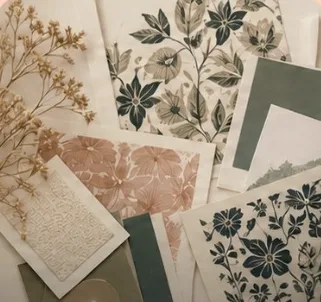
 Fabric designsPrinted by the yard
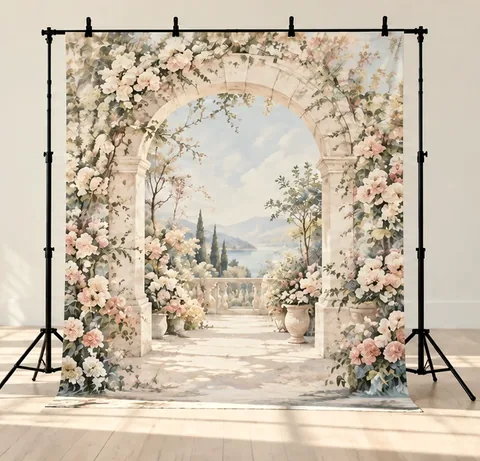 Backdrop designsPhoto backdrops to hang
How much fabric you need for pillow covers
Updated
For an 18-inch pillow cover you need about 5/8 yard on fabric 56 inches or wider, or 1 yard on narrower fabric, using an envelope back. Measure the insert seam to seam and cut the front the same size for a plump cover. One yard of wide fabric makes about two 18-inch covers.
Measure the insert, then decide the fit
Measure the pillow insert from seam to seam, not the old cover. For a plump, well-filled look, cut the front the same size as the insert. With 1/2-inch seams the finished cover comes out an inch smaller, and the filling pushes right into the corners. For a softer, slouchier cover, add 1 inch to each side measurement before cutting. Every figure below uses the plump method and a 1/2-inch seam allowance.
How to cut an envelope back
An envelope back is two overlapping panels, so there is no zipper to set. Each panel is the full width of the front and a little more than half its height. A reliable rule: front width by half the front height plus 4 inches. Hem one long edge of each panel with a double 1/2-inch fold, which uses 1 inch.
For an 18-inch cover, that is a front at 18 x 18 inches and two backs at 18 x 13 inches. After hemming, the panels overlap by 6 inches, enough that the insert never shows and the cover stays closed on a sofa that gets used.
Yardage by pillow size
These amounts assume fabric at least 53 inches wide, pieces laid out side by side where they fit, and no pattern matching.
16-inch: front 16 x 16, backs 16 x 12. All three pieces fit across one width. Order 1/2 yard.
18-inch: front 18 x 18, backs 18 x 13. On fabrics 56 inches or wider the three pieces fit across, so 5/8 yard is enough. On narrower fabrics, order 1 yard.
20-inch: front 20 x 20, backs 20 x 14. Two pieces fit across and one goes below. Order 1 yard.
22-inch: front 22 x 22, backs 22 x 15. Order 1 1/4 yards.
24-inch: front 24 x 24, backs 24 x 16. Order 1 1/4 yards.
12 x 20 lumbar: front 20 x 12, with the envelope opening across the short side, so two backs at 14 x 12. All three fit across one width. Order 1/2 yard.
Fine Rib is narrower, at 47 inches, so fewer pieces fit side by side. Sketch the layout on paper before ordering it.
Large prints and pattern matching
Those numbers assume you can cut anywhere. A large motif changes that. To center a bouquet or medallion on the front, the motif has to land in the middle of the square, which can mean skipping fabric to reach the next repeat. Add one full repeat length for each cover you want centered.
The back panels rarely need matching, since they overlap. A pair of covers on a sofa does look deliberate when both fronts are cut from the same point in the repeat, so buy for that if the pair matters. Before buying extra, try the scale setting: making a motif smaller so it repeats neatly across the face, or larger so one motif fills it, often saves more fabric than ordering another yard.
Fabrics that make good cushions
Cushions get leaned on, so choose an opaque fabric of 200 GSM or more.
Heritage Linen Look (360 GSM) is the most substantial, with a pronounced woven texture and a tailored look.
Plush Velvet (250 GSM) has a pile that shifts shade with direction. Cut every front with the pile running the same way, or a pair will look like two different colors.
Signature Herringbone (260 GSM) has a directional weave. Match the herringbone direction across seams and between covers.
Pebble Matte (260 GSM) has a fine pebbled surface and no luster. Press it on the reverse at low heat to keep that face.
Artisan Canvas and Artisan Twill (both 200 GSM) are everyday workhorses, and Suede Touch, Luminous White Out and Fine Rib all list cushion covers among their uses. Vanilla Heritage Linen Look (270 GSM) is partially translucent, so line the front or the insert will shadow through.
Skip the lightest fabrics. Chiffon, Crepe and Stretch Mesh are too sheer, and Pearl Sateen, though opaque, is too light to hold a crisp shape.
Sewing notes
Clip the corners diagonally before turning, trimming close on heavy fabrics so the points come out sharp. If square covers tend to form pointed dog ears with a full insert, taper each seam inward by about 1/2 inch over the last 3 inches before the corner. Finish raw edges inside with a zigzag or serger on fabrics that fray, since the cover will come off for cleaning. Prefer a zipper? Cut the back as two halves, each half the front height plus 1 inch for the zipper seam. The yardage above still covers it.
Before you order
Order a swatch of the fabric you have in mind and wrap it around a corner of the insert to see how it feels and whether anything shows through. For mixed sets, a fat quarter is a quarter yard cut wider and squarer, enough for the front of a 16-inch cover. Make the fronts from fat quarters of several designs and the backs from one coordinating yardage, and the set will look planned rather than matched.
Fabrics in this guide
Popular collections
More guides
Questions
How much fabric do I need for an 18-inch pillow cover?
About 5/8 yard on fabrics 56 inches or wider, or 1 yard on narrower fabrics. That covers a front at 18 x 18 inches and two envelope back panels at 18 x 13 inches. Add one pattern repeat if you want to center a large motif.
Should a pillow cover be smaller than the insert?
For a full, plump look, yes. Cut the front the same size as the insert and sew with 1/2-inch seams, so the finished cover is an inch smaller. For a softer look, add 1 inch before cutting.
How much overlap does an envelope pillow back need?
Aim for 4 to 6 inches. Cut each back panel at half the front height plus 4 inches, hem 1 inch, and you get about a 6-inch overlap.
How many pillow covers can I make from one yard?
With fabric at least 53 inches wide, one yard makes two 16-inch covers, two 12 x 20 lumbar covers or one 20-inch cover, all with envelope backs and no pattern matching.