
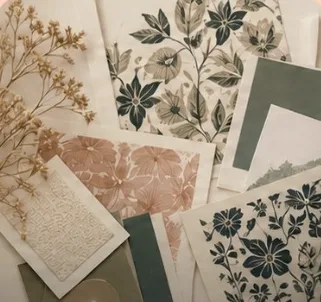
 Fabric designsPrinted by the yard
 Backdrop designsPhoto backdrops to hang
Choosing fabric for dresses, blouses and skirts
Updated
For blouses, choose a light, fluid fabric such as Crepe, Chiffon, Feather Lawn or Pearl Sateen (70 to 100 GSM). For flowing dresses use the same group; for structured dresses choose a heavier fabric with body, such as Artisan Twill. Most Huevara apparel fabrics are woven with no stretch, except Stretch Mesh, Comfort Jersey and Scuba.
Read the pattern envelope first
A sewing pattern already tells you a lot. The suggested fabrics hint at drape: a pattern that calls for crepe, challis or georgette needs something fluid, and one that lists twill or gabardine wants body. The envelope also tells you whether the design is drafted for wovens or knits. Most Huevara apparel fabrics have no stretch, so choose patterns drafted for woven fabrics. The exceptions are Stretch Mesh, with four-way stretch, and Comfort Jersey and Scuba, with moderate stretch; each fabric page lists its stretch.
Blouses and shirts
Pearl Sateen (100 GSM, opaque) is the most versatile choice. It is supple, falls in broad folds, has a subtle sheen and needs no lining, so it suits camisoles, relaxed shirts and blouses with soft gathers.
Crepe (70 GSM, partially translucent) has a fine textured surface and graceful movement, ideal for loose tops, tunics, flutter sleeves and ruffles.
Feather Lawn (100 GSM, partially translucent) has a fine, even weave and gently defined folds, so collars and button bands stay neat. Use it for lightweight shirts, blouses and kaftans.
Chiffon (80 GSM, translucent) is for sheer blouses and layering shirts worn over a camisole. Signature Linen Look (100 GSM, partially translucent) gives a loose, boxy blouse a relaxed texture.
Luster Satin (100 GSM, opaque) has a high-shine finish for occasion blouses and camisoles. Comfort Jersey (160 to 180 GSM, opaque, moderate stretch) is the pick for T-shirts and relaxed knit tops; choose patterns made for knits.
Dresses
For a slip dress or anything that skims the body, use Pearl Sateen. It is opaque, so it can be worn unlined, and its sheen gives a print a polished finish.
For a flowing wrap or tiered dress, Crepe or Feather Lawn, lined or layered, since both are partially translucent.
For occasionwear with movement, Chiffon over a Pearl Sateen underdress.
For a dress that holds its own silhouette, like a sheath, a fit-and-flare or a peplum style, use Scuba (270 GSM, opaque, broad rounded folds) or Suede Touch (250 to 300 GSM, opaque). Scuba holds its shape well enough that seams can be left unfinished on structured pieces, which keeps them flat under a fitted bodice.
Skirts
Flowing skirts come from the light end: Pearl Sateen on its own, or Crepe and Chiffon over a lining. A skirt with shape needs body. Artisan Twill (200 GSM, opaque, pronounced diagonal rib) handles A-line and straight skirts. Signature Herringbone (260 GSM) suits tailored skirts, and its herringbone direction should match across seams. Scuba makes crisp A-line skirts, and Suede Touch gives a skirt a soft, substantial hand. For a skirt with volume but little weight, layer Stretch Mesh over a lining.
Opacity and linings
Hold the fabric up to a window with your hand behind it. If you can see your fingers, plan for a lining or a layer underneath. Pearl Sateen, Artisan Twill, Scuba and Suede Touch are opaque. Crepe, Feather Lawn and Signature Linen Look are partially translucent. Chiffon and Stretch Mesh are translucent.
Pearl Sateen is the natural lining for the lighter fabrics. It is opaque, light at 100 GSM and smooth enough for an outer layer to slide over it. Cut the lining from the same pattern pieces, about an inch shorter at the hem, and join it at the neckline and armholes or at the waistband. For a coordinated finish, print the lining in a quieter colorway of the same design, when it has one, or in a small-scale print.
Layering sheer fabrics
Sheer layers are where printed fabric gets interesting. A Chiffon overlay on a Pearl Sateen underdress softens the print beneath, and printing the same design on both layers at different scales adds depth without clashing. Stretch Mesh over a lining adds a fine mesh texture, and its four-way stretch makes it forgiving for sleeves and overlays.
A few rules for sheers. Cut them in a single layer over tissue paper so they don't shift. Use a fine, sharp needle and a short stitch. Sew French seams, so nothing shows through from the outside. Chiffon and Stretch Mesh are very light, so finish every edge carefully; a narrow rolled hem is the cleanest finish on a Chiffon overlay.
Test, then cut
Order swatches of the two or three fabrics you are torn between and pin them at your shoulder in front of a mirror. Check the drape, the opacity and how the print scale sits on your frame, because a motif that looks right on a screen can feel large across a blouse front. You can adjust any design's scale before ordering, and the swatch kit lets you compare our fabrics side by side.
Fabrics in this guide
Popular collections
More guides
Questions
What is the best fabric for a blouse?
For an opaque blouse that needs no lining, Pearl Sateen. For a softer, airier blouse, Crepe or Feather Lawn, worn over a camisole or lined. Chiffon suits sheer blouses and layering.
Which fabric is best for lining a dress?
Pearl Sateen. It is opaque, light at 100 GSM and smooth, so outer layers like Chiffon, Crepe or Feather Lawn hang well over it.
What fabric works for a structured dress?
Scuba (270 GSM) or Suede Touch (250 to 300 GSM). Both are opaque and hold a shape, so they suit sheath and fit-and-flare dresses, A-line skirts and peplum tops.
Do Huevara apparel fabrics stretch?
Most have no stretch, so use patterns drafted for woven fabrics. Stretch Mesh has four-way stretch, and Comfort Jersey and Scuba have moderate stretch. Each fabric page lists its stretch, so check it before cutting a fitted pattern.